Leverage without support
Open Interest can rise while volume falls. More positions do not always mean a healthier trend.
RADAR turns 7 CoinGlass derivatives data points into a structured diagnosis: a 0–100 Risk Score, Long/Short bias, liquidation zones, confidence, and suggested exposure. A short workflow once familiar, using the AI you already have.
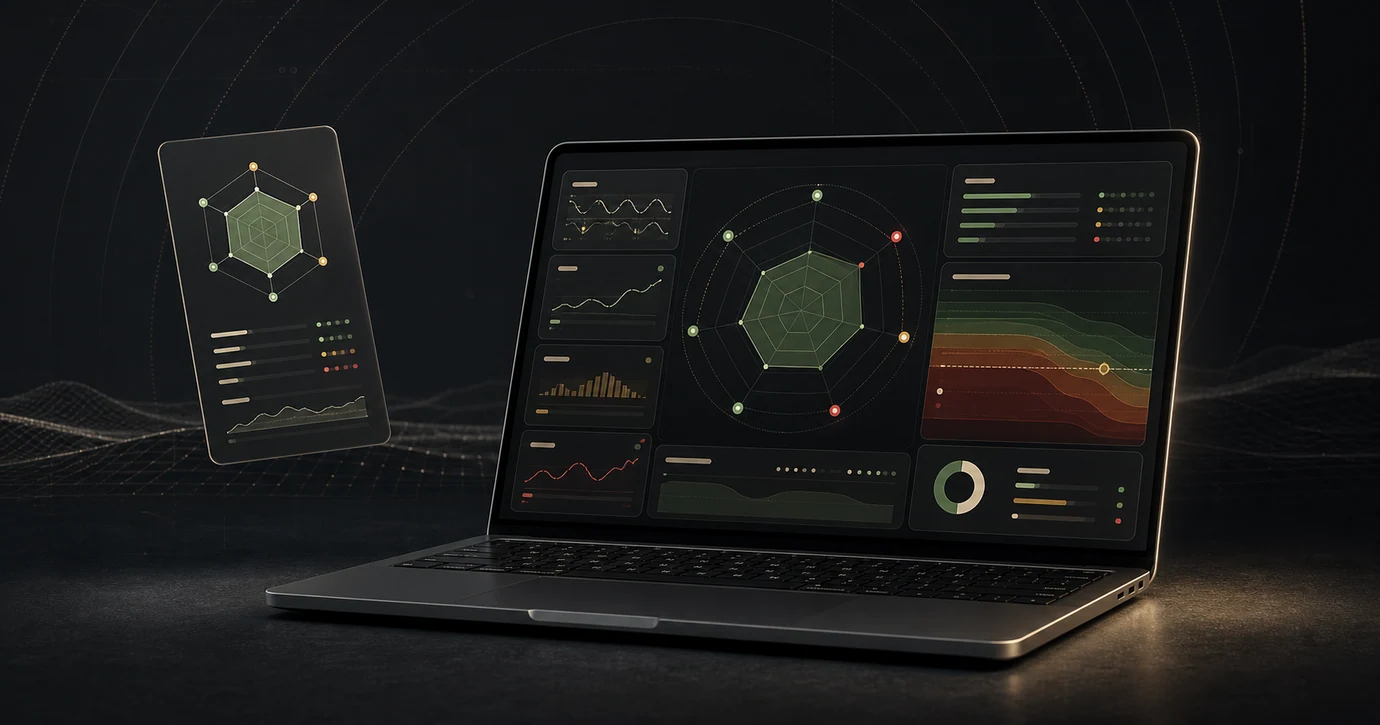
It does not replace your strategy or predict the market. It adds a pre-trade layer for reviewing derivatives risk before taking exposure.
A technically sound entry can still fail.
Extreme funding, rising leverage, Open Interest without volume, and nearby liquidation clusters can turn a good technical setup into a fragile environment.
Open Interest can rise while volume falls. More positions do not always mean a healthier trend.
Extreme funding and Long/Short Ratio readings help expose when too many participants share the same bet.
A large liquidation cluster near price can act as a magnet and amplify a sharp move.
It does not replace your strategy or predict the market. It adds a pre-trade layer for reviewing derivatives risk before taking exposure.
Three steps. Your data. Visible criteria.
You do not connect an exchange, share keys, or need a paid AI plan. You paste the data and RADAR requires the model to analyze it with a defined rubric.
Open RADAR in Notion and paste the full prompt into ChatGPT, Claude, or Gemini.
10 secondsCheck CoinGlass and paste only the current values requested by the prompt.
≈ 1 minuteReceive the score, dashboard, bias, key zones, exposure, invalidation, and validity.
≈ 30 secondsEach indicator adds a different piece. RADAR cross-checks them instead of deciding from one number.
Value and change used to identify expansion or hollow leverage.
Cost between longs and shorts and potential positioning extremes.
The densest clusters above and below current price.
Leverage level compared with its recent range.
Concentration of accounts and volume on each side.
Confirmation or divergence against price and Open Interest.
A second signal for aggregate derivatives risk.
It is more than a loose prompt.
You receive an import-ready Markdown page for Notion, organized so you can begin even if you have never reviewed derivatives in a structured way.
Copy-ready instructions with a mandatory report format.
Thresholds for scoring each indicator without vague intuition.
Where to find every data point and exactly what to copy.
A complete diagnosis that shows how to read the output.
OI, funding, liquidations, leverage, Long/Short, and CDRI in plain language.
Usage frequency, altcoin reliability, and educational scope.
Because you provide the data, RADAR does not require web browsing or a paid model plan. The diagnosis is only as reliable as the accuracy and freshness of those inputs.
Get RADAR free↗This is what a completed reading looks like.
Illustrative example based only on the values shown. It is not a current-market reading, and its bias is not a probability of future price.
BTC · OI $38.2B (+4.1% 24h) · Funding +0.032% · lower cluster at $97,400 · leverage near 30d highs · 63% long · volume -18% · CDRI medium-high
Leverage expanding without confirmation from volume
−2Caution zone; long positioning is becoming expensive
−1Near the top of its recent range
−263% of the market concentrated on the long side
−1Large lower cluster close to current price
−2“Long-side overleverage without volume confirmation: an environment that demands patience, not certainty.”
Two tools. Two different decisions.
RADAR can stop you from ignoring the environment. EDGE SYSTEM turns that reading into a complete process you can see, measure, and review.
Your next pre-trade check can be different.
Complete the free access flow on Gumroad and receive both the Spanish and English editions, ready to import into Notion.
Free access processed and delivered by Gumroad.
An educational tool, not a signal.RADAR organizes a reading from the data you provide. It does not guarantee outcomes or remove the risk of loss.
Before you use it
No. It provides a structured reading of the derivatives environment and an educational exposure suggestion. The decision, strategy, and risk remain yours.
No. The workflow is designed for you to paste the data, so it can work with free versions that accept the full prompt.
It can, but derivatives readings are less reliable when an asset has low liquidity or incomplete data. BTC and ETH generally offer stronger information.
Before an entry and again when the data has changed materially. As an educational reference, the guide suggests repeating it after 4–6 hours or a strong move.
No. Technical analysis can help define where; RADAR adds derivatives-risk context before you decide whether to take exposure.
After completing free access on Gumroad, you can download both editions and import the one you prefer into your Notion workspace.
RADAR is a focused pre-trade check. EDGE is the complete operating system: rules, session protocol, setups, risk, journaling, validation, and review.